Self-Levelling Compound or Floor Screed: What to Use
23 August 2026 · All4Building.ie team
Two products, two different jobs
"Levelling the floor" gets used for two different jobs on site, and mixing them up costs time and material. Self-levelling compound is a thin, self-smoothing layer poured just before the final floor covering goes down. Floor screed is a heavier-bodied product used to build up depth, take out real unevenness, or bury underfloor heating pipes before anything else touches the slab. Reach for the wrong one and you either waste an expensive self-levelling compound trying to fill a big dip, or end up with a screed finish too rough for a thin vinyl or click floor to sit on.
What depth range each product covers
Every self-levelling and screed product has a stated depth range on the bag, and that range is the fastest way to work out which one you need for a given floor.
| Product | Typical use |
|---|---|
| Baumit Quick-Set Self-Levelling Compound 5-30mm | Quick-set finishing layer on a reasonably flat slab before flooring goes down |
| Sopro Floor WS 3.50 Self-Levelling Compound 3-50mm 25kg | Wider depth range, useful where the floor has more variation from one end of the room to the other |
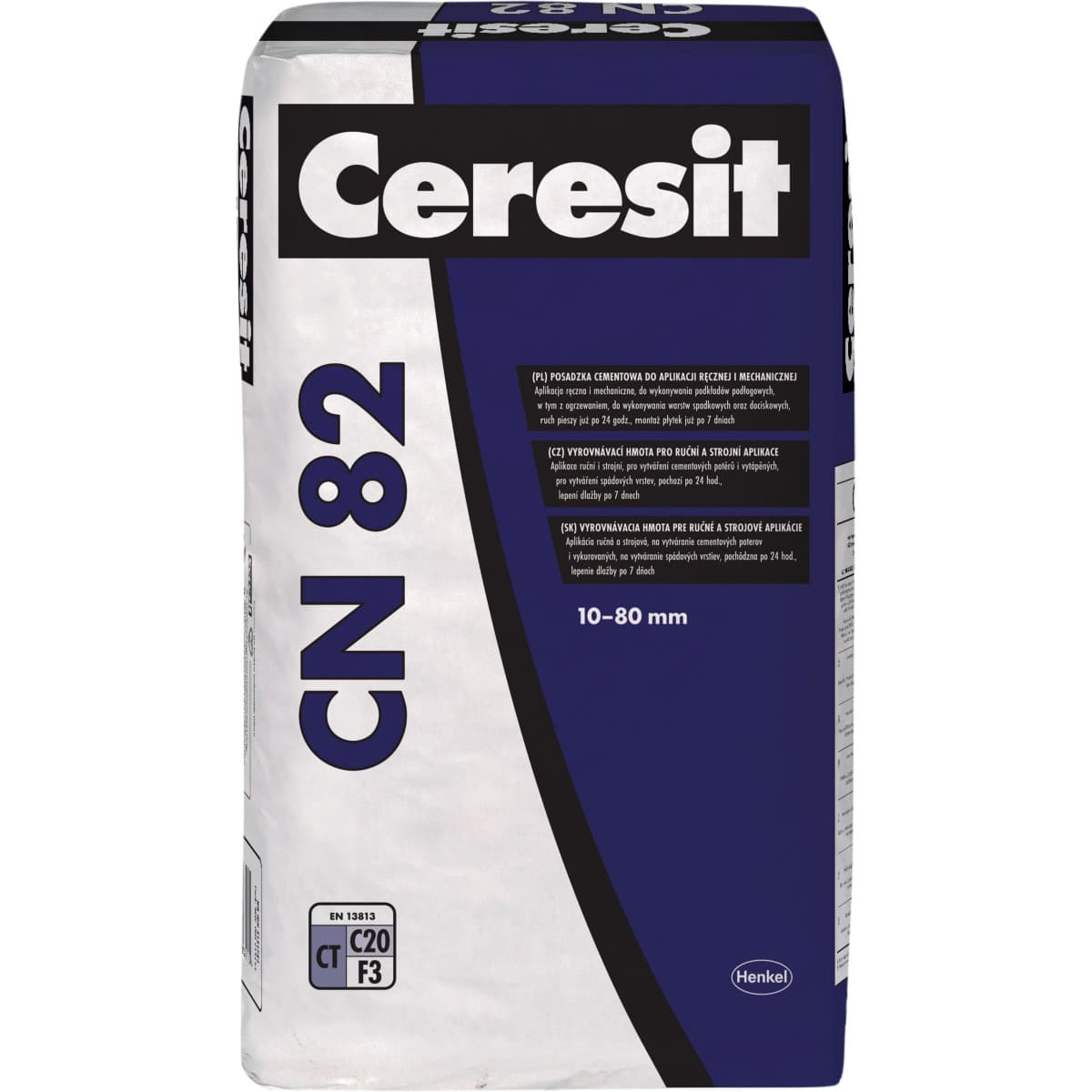
| Ceresit CN-82 Floor Screed 10-80mm 30kg | Building up real depth, covering pipework, or correcting a substrate that is genuinely out of level, not just slightly uneven |
Check the datasheet for the exact minimum and maximum pour depth, drying time and coverage per bag before you order. These vary by product and by how thick a single pour can go before it needs to be built up in stages, so we would rather point you to the datasheet than guess a figure here.
When you need a floor screed, not a self-levelling compound
If you can see the dip or slope across a room, if there is underfloor heating pipe to bury, or if you are working off a new slab that was never meant to be a finished surface, that is a screed job. Ceresit CN-82 is built for that depth of work. Trying to pour a self-levelling compound to the same depth in one go usually means it cracks as it dries, because that is not the job it was designed for.
When self-levelling compound is enough
If the floor is basically flat and sound but has minor dips, trowel marks, or old adhesive residue that would telegraph through a thin floor covering, a self-levelling compound is the right call. It is quicker to mix and pour, and it is designed to find its own level and dry flat with a smooth, sound finish ready for flooring or tiles. For floors with a bit more variation across the room than a standard product handles, the wider range on Sopro Floor WS gives more room to work with in one pour.
Priming before you pour
Self-levelling compound and screed both need the substrate primed first on anything porous, such as a sand and cement screed, old concrete, or a floor with patchy old adhesive residue. Skip the primer and the pour can dry too fast at the surface, or the compound can pull moisture out unevenly and crack or pin-hole once it has gone off. Cekol DL-80 Deep Penetrating Primer 10L is suited to larger areas, and Cekol Quartz Sand Bonding Primer 5kg gives a keyed, sanded surface for extra grip where the substrate is smooth or dense. Let the primer dry fully before you pour, the datasheet will tell you how long that takes for the conditions on site.
A common mistake worth avoiding
Pouring self-levelling compound over an unprimed or dusty floor to save a step, then finding it has debonded in patches once the flooring goes down and gets walked on. The primer coat takes an hour or so and it is the difference between a pour that stays flat for the life of the floor and one that has to be dug out and redone. The same goes for trying to stretch one bag of self-levelling compound across a dip it was never rated for, rather than screeding that section first.
Browse the full range in Self Leveling Compounds, or see Primers for the priming products above.
Get your materials list sorted before you start
Send us the room dimensions and roughly how deep the low points are, and we will work out whether you need a screed, a self-levelling compound, or both, and how much to order. In-stock orders go out within 7 working days, and delivery is free in Ballincollig and Cork City. Collection is by appointment only, so give us a shout first.
Call 085 868 8459 or email sales@all4building.ie and we will sort the list out with you.
Need materials for this job?
We deliver trade-quality building materials across Ireland. Call 021 487 6963 or message us on WhatsApp for a quote.
Shop now